Tracking Success in Shark Restocking (ES)
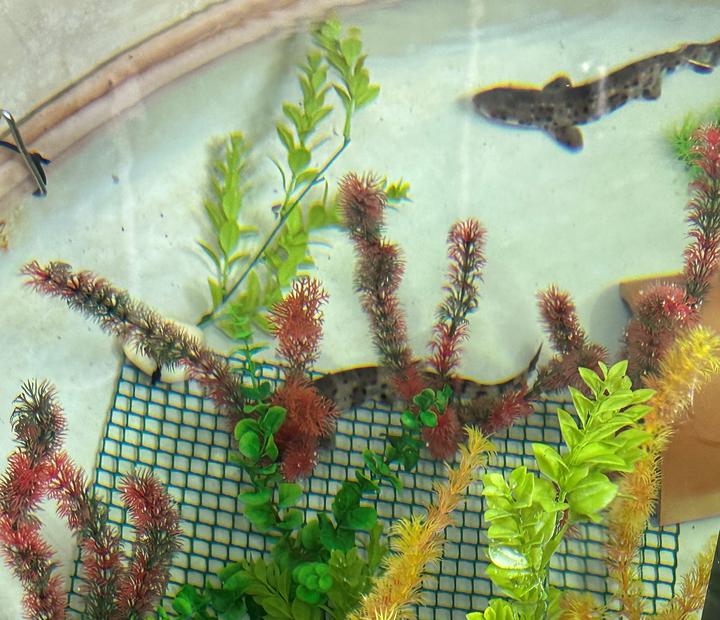 Do environmental enrichment improve survival for released Nursehound dogfish?
Restocking programs to support and maintain local populations are increasingly applied to marine species with low growth and reproduction rates, such as the bottom dwelling Nursehound dogfish (Scyliorhinus stellaris). However, the effectiveness of these releases is often difficult to evaluate. Recapture rates are low, and traditional surveys offer only limited, discontinuous information, leaving post release survival and behavior largely unknown.
High resolution acoustic telemetry provides a solution by enabling detailed monitoring of shark movements and habitat use in a defined core study area. By tagging released individuals with acoustic transmitters and tracking them with a high density receiver array, we can obtain fine scale data on residency, space use, and post release behavior—when adaptation and mortality risks are highest. Subsequent detections from the broader Balearic Tracking Network (BTN) further extend our ability to document dispersal beyond the focal area.
This project uses high resolution telemetry to (1) improve ecological understanding of Nursehound dogfish behavior, (2) quantitatively assess the success of a breeding and release program at ecologically relevant spatial scales, and (3) contribute detections to the Balearic and European Tracking Networks (BTN and ETN).
Importantly, sharks reared under different captive conditions are included, allowing us to test whether environmental enrichment improves post release performance. High resolution telemetry in the core study area is essential for linking captive rearing practices to real world outcomes and for informing future restocking, conservation, and management strategies.
Funded by the Complementary Plan for Research, Development and Innovation (R&D&I) in the Area of Biodiversity of the Balearic Islands (project ref. BIOPRO2024-015).
Project Partners
- Dr. Pablo Arechavala López (IMEDEA/CSIC (MARES))
- Dr. Jose María Valencia (LIMIA-IRFAP)